A Dive into Academia with Professor Nivedita Sinha

Updated: May 20, 2025
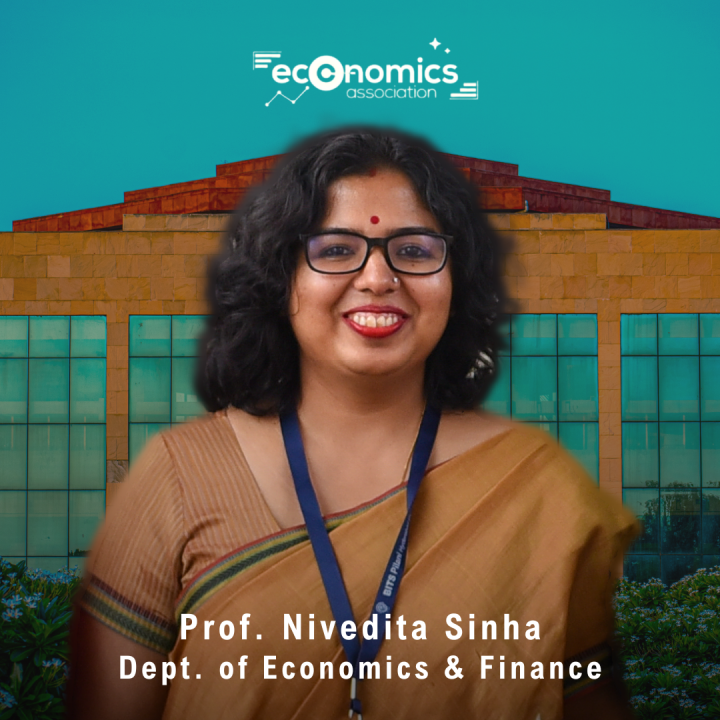
The Economics Association had the pleasure of sitting down with Professor Nivedita Sinha, of the Department of Economics and Finance at BITS Pilani, Hyderabad Campus. With a deep passion for teaching and research, Professor Nivedita brings a unique perspective to economics, blending theoretical knowledge with real-world relevance. In this conversation, she shares her academic journey, insights into finance courses at BITS, and advice for students navigating the field. We are grateful to professor Nivedita for her approachability, and inspiring teaching style that has impacted countless students over the years.
Q: Many students may not know that you began your journey as an engineering student, earning a Gold Medal at NIT Surat in Electrical Engineering and even worked in the field for some time. What led you to the transition from engineering to academia, particularly the field of finance?
Yes, I’m an Electrical Engineer from NIT Surat. I really enjoyed my core engineering experiences; I worked as a power systems consultant and a design engineer in an MnC. There was no planned decision of moving from industry to academia. I always had a zeal to learn things. I used to read a lot about the market, as well as business news, and what particularly excited me were the MnA deals happening in the industry. That led me to explore more, learn more, learn about how valuation is done and get into finance.
One incident which I remember is, during my convocation, I got a letter from NIT alumni association which encouraged me to pursue higher education, since I was good at academia and academics. So, everything put together, along with the zeal to learn something new led me to do a PhD in finance. I was directly admitted into a PhD program because I already had three years of work experience after my engineering. My PhD program at IIM was an integrated one in terms of coursework; you have MBA coursework in the first year, and then get into your PhD. I didn’t plan on getting into teaching or academics as a profession. I initially looked for corporate finance roles, after my PhD. During that time, I remember giving the second-round interview for a finance role in a core company, and at the same time I got an offer from a prestigious Indian institute to join academics. So, I thought of giving it a shot. I hadn’t really planned the decision in advance, I took everything as it came.
Q: You have also done a Post Graduate Diploma in AI & ML from IIIT Bangalore. With a lot of development being done in AI lately, how prominent is it in the field of finance? Also, how do you keep yourself up to date with the latest developments in finance, given that is quite a fast-moving space?
As I mentioned previously, I have always had the zeal to learn, and I was seeing a lot of development happening in the field of AI and ML. I was good with data econometrics in the courses in my PhD program and I liked coding even during my engineering days. I was actually looking for a professional development kind of a course instead of a degree course, and I found this program at IIITB really interesting. It had a lot of projects and assignments. I did this course as a professional development because I also had a lot of students coming for projects where they wanted some link between CS and Economics or CS and Finance.
Currently I’m involved in a lot of projects on AI and ML in finance. We are collaborating with RMIT for a PhD program, our topic has been approved on AIML in finance, using LLMs to analyse annual reports and coming up with certain scores, which are not directly publicly available. The institute also has a cross-disciplinary research program where I have a project on recommender systems. In addition to that, we also had a Sparkle project on bankruptcy prediction using AIML. Recently I’ve been doing a lot of papers with students. There was one about sentiment analysis when it comes to IPO pricing. Another paper is on a bilateral relationship score which we developed using textual analysis and its relation to offshore venture capital financing. These two papers have recently received best papers awards in international conferences. So, there is a lot of work which I do on AIML in finance with students as well as faculty. I keep myself updated by going through a lot of research papers and business news. I would suggest students to go through business news as well. Try to link whatever is being taught to current news, and try to see the practical application of what you’re learning.
Q: You’ve had quite an interesting career path, studying three different domains, during your education, Electrical Engineering, AI & ML and then Finance. How did you keep yourself motivated during the journey, and excel in everything over a long period of time?
I never really saw them as different domains, though they might seem to be so. As I mentioned, I did power system consulting with my knowledge in Electrical engineering. For any project, we used to figure out if it is viable to take it up. If you see the finance courses which I’m teaching, we always discuss whether we should go ahead with a particular project or not. Finance is about financial decision-making in any business. In addition to core knowledge, it is always good to have finance and economics knowledge to understand the overall business. I was fortunate to work in an MnC which gave us those opportunities. We used to sit through CFO presentations and understand the finance aspect of the engineering domain as well. A lot of training was provided to me. We had executive management training which the MnC itself provided.
It is a good opportunity for you students that BITS is offering a minor degree in finance because we didn’t have it when we were doing engineering. In addition to the core domain, try to understand how it is linked to the overall business. I don’t see it as separate. I always enjoyed all the things I worked on, as an Electrical Engineer as well as in finance.
The courses which I liked, I really went through in detail, and those courses I didn’t like, I left it till the end, similar to what most engineering students usually do :)) In that way, I was able to manage my CGPA. I was always motivated to learn new things. If you like the things you do, you keep updating yourselves, and you don’t see it as a burden. Although you have so many courses to do, focus on things you like doing and the things you feel you won’t get tired of doing, that’s how I kept motivated. BITS gives you a lot of exposure as well, so make the best of that.
Q: You completed your PhD at IIM Bangalore, could you share some insights from your PhD journey—what it was like, the challenges you faced, and the things you took away from that experience?
My PhD Journey at IIM Bangalore started with the MBA coursework as I mentioned. So, the first year was quite competitive. There was a strict GPA cut-off criteria to be eligible for the PhD program. It was a very good learning experience. There were a lot of group assignments, so I got to work with a lot of highly motivated people. The second year consisted of electives and PhD level courses which are more research oriented.
The first two years were entirely coursework. Then you start figuring out your research question, which is always challenging, and you have to keep yourself motivated. It is an uncertain field because there is no time limit to it. It may take five years, it may even take seven. It was a challenging experience for me because I went from engineering to a research-oriented field which was quite different. So, I had to learn a lot of things which I did through peers, colleagues, faculty and students. It was a very nice journey. I learnt a lot about the different academic fields that were out there, and I’m still learning!
Q: A bit of a follow-up from the previous question. Pursuing an MBA after engineering is quite a popular career path, with IIMs being a top choice. Having been at IIM Bangalore and teaching at business schools, including IIM Calcutta, what are your thoughts on the engineering-to-MBA path? What do you think are the key factors that students should consider when making this decision?
I’ve always felt you should have some years of work experience before pursuing an MBA. You’ll be able to understand the curriculum better and relate it to the industry. I worked for a manufacturing setup, so it was easier for me to relate to all types of courses, be it in managing organizations, be it marketing. I remember doing the course and relating it to the workings in the company. So I’d recommend at least one year of experience before you do your MBA.
Now, there are various fields in management. IIMs give you a general management exposure, with many elective choices, you can do marketing, you can do strategy, you can do finance, to name a few, whatever interests you. Students at BITS can go through the courses offered in the Minor in Management to understand their interests in the field.
Q: You’ve previously taught at renowned business schools in the past, what motivated you to join BITS Pilani? Given its strong reputation in engineering and science, choosing it for a career in finance academia seems like an unconventional path. What drew you to this institution?
I had to move from Kolkata to Hyderabad due professional as well as personal reasons. I didn't know at that time that BITS offered a minor in finance. I was under the impression that they were all about engineering, and that they didn't teach finance. When I was working in Hyderabad at a management institute, I met Professor Sunny, whom you might know from the Economics Department here at BITS. He mentioned that there is a finance minor program at BITS and asked me if I’d like to apply. What motivated me is that I always loved my engineering domain. I was quite happy to know that engineering students were offered Finance electives in the same college. So that connected with me, because of my engineering background.
Q: Having been at BITS Hyderabad for nearly six years, Over the years, how have you seen BITS Hyderabad evolve, both academically and culturally? Are there any specific changes that stand out to you and how has your experience been at the institute so far?
Yes, it has been a very good experience so far. I have good colleagues whom I learn a lot from. I feel BITS gives a lot of opportunities to academicians, in various different fields, and I have really learnt about what all can be done as an academician: applying for projects, collaborations with other renowned universities as well as interdisciplinary collaborations. There is also a lot of research funding which BITS provides, as well as opportunities for faculty to incubate a startup.
As far as culture goes, I think every engineering college has a culture in itself. It’s a similar feeling to what I felt at my engineering college, which is a very enjoyable period in one’s life. I would say that the 4-5 years that you get here are unlike what you can get even from an MBA college or any other. You have lifelong friends and a really good atmosphere, which is really a different type of vibe.
Q: Students are aware about the courses you take, but outside the classroom, what does your typical day look like? Do you have any favourite places around the campus or in Hyderabad?
A typical day starts with going over what I’m going to teach, that particular day. Usually, I have classes at 10 a.m. After that, I go for tea with my colleagues, where we discuss a lot of ideas. There are meetings with project and PhD students as well as my own research work, including writing proposals for projects. So yeah, my day is filled with colleagues’ interaction, student interaction and project work.
I’ve stayed in various places around the country. I’ve lived in Gujarat for my engineering, and studied in Bihar, during my schooling. I also spent quite a few years in Bangalore and Bengal. I like Hyderabad as a place for family. It feels like a place where people are very family oriented. My favourite place in BITS is the road surrounding the old football ground. I often go walking around there. As far as the city goes, I don’t venture into it too much, I’m happy within the walls of my home, either doing painting or reading a novel. I like having my own space.
Q: This semester, you’re taking Financial Management and Business Analysis and Valuation, both very popular courses, being a part of the finance minor that BITS offers. What are your thoughts on the finance minor and do you have any advice for students who are taking it, or might be thinking about pursuing it?
Finance courses which I teach are about understanding the financial decision-making aspect of any company. Wherever you work, you should know the core business and how the business is impacting the numbers: how to analyze the business, what are sources of revenues, sources of costs, cash flow projections, value to shareholders. There are a lot of companies where you can use the knowledge of both core and finance.
With a Minor in Finance, you can not only join investment banking firms but also join treasury analyst roles at core companies. BITS is offering the exposure to do a minor in finance, which not all engineering colleges do. At least try to take one course to understand what it is about, even if you don't want to go through the full minor in finance. Then, if you find that you like having this finance knowledge, it's an exciting path to pursue.
Q: Following up on the previous question, do you have any tips for students pursuing these courses to do well in them?
Attend classes :)) I think you have to be regular, even if you're not attending. At least know what has been done for the week. What I find here is that students don't interact much with their peers. I feel like you don't know everyone in your class. I think it's because you are from different years or branches or something like that.
At least form a group where you can do group study. Group study always helps. There would be someone who is better at finance than someone else. Have a group where you have a lot of different people. Discuss and study and be regular in your studies.
For finance, I always say go through business news and try to see how you can relate it practically. To do well in courses, you need a lot of practice. You should have good math skills. You should understand the concept, don't look at it as just solving an equation, although we have a lot of equations. First, try to understand the concept and then go about solving the question.
Q: BITS being an engineering college, I’ve noticed most courses emphasising a lot on problem solving. Finance is a field that heavily relies on real-world application. Having been in the world of finance for a long time, what do you think is the right balance of theory and practice to best prepare students for the industry?
You have to understand the theory to solve the problem. It should not be just, this is the equation, and I put in the values in the equation and get it. You have to understand what is going on in that particular problem. That's why, if you see, for BAV, we have a lot of case studies because you need to understand what the problem is at hand. What is the theoretical concept behind it? It should not be only just problem-solving. The problem-solving is, in a way, applying the theory and solving the case.
Q: How do you ensure that courses are industry relevant? In BAV in particular, there is a lot of emphasis on case studies, like you mentioned. Are there any other techniques, or teaching methods you try to incorporate to enhance the courses?
For assignments in class, we try to apply the concepts and analyze using real data. The assignments involve analysis using Python programming. What we’ve found in the industry is that they often see if an engineering student can apply concepts using programming techniques. This is particularly the case in investment banking. They may ask how you can apply these concepts, test them using programming techniques. That’s an advantage for an engineering student, you have that coding experience, and you can link it to financial concepts. That's why I’ve tried to bring a lot of applications and coding into the courses. For example, we usually conduct risk analysis for valuation using Monte Carlo simulations, again in Python. I’ve also taught SAPM (Security Analysis and Portfolio Management), where we do a lot of portfolio optimization using programming techniques. Earlier, we would do everything in Microsoft Excel using a lot of add-ins in Excel for simulations. But now, with programming, you can write your own code . That’s one of the new things I’ve introduced in the courses.
Q: Since finance courses at BITS are taken by students from diverse academic backgrounds—engineering, sciences, and economics—do you try to modify your teaching approach to accommodate this diversity, and do you think it’s beneficial for students from different disciplines to take up finance courses?
Although people are from different engineering domains, one thing I try to tell them is you should have a particular level of maths background for problem-solving. Particularly in courses like SAPM, you have calculus as well. In previous years, I found some students in particular domains finding it hard. You do have students from engineering, science, and pharmacy backgrounds. I don't find it very diverse in the sense that the problem-solving skills are all similar. The only diversity which I try to cater to is in giving examples. If you see my current BAV question paper, I try to relate a lot of engineering examples with their finance aspects. I try to give them examples from each domain, I still need to hear from students as to whether they relate to it or not. I mean, whether they appreciate it or not?
Q: You've spoken a bit about some projects that you've worked on. Are there any that are currently ongoing that you'd like to talk about? And do you have any advice for students who are looking to work on formal projects with professors, like any skills that you look for?
There are three research areas I would put as my main interests. One is AI/ML in finance, where I am working on a lot of projects with students as well as interdisciplinary work with the CS department. That’s one big domain. When I did my PhD, my focus was primarily on corporate governance. I currently have a PhD student working in that field. Another major focus has been bank consolidation, analyzing market reactions to bank consolidations and examining how bank lending relationships were impacted. So, the three major areas are AI/ML in finance, corporate governance and bank consolidation.
For AI/ML in finance, like I mentioned, I’ve done a lot of projects in the domain. It’s a field which is quite dear to me, especially in applying AI/ML techniques in accounting and finance. One aspect we’ve explored is extracting insights from accounting statements that are not immediately visible, like analyzing the tone of financial statements. We’ve also conducted sentiment analysis on news articles to see how it impacts financial decisions. So, I’m trying to apply a lot of AI/ML techniques in finance, and that remains a key focus in my research.
Mine is mostly empirical work, so I look for students who have done a course on Financial Management, who know core finance. In addition, some programming skills and econometrics or ML, because we handle a lot of data, so data analysis is important, either in R, Stata, or Python.
Q: Lastly, is there any advice you have for students, from your vast experience, that could help them navigate their academic journey?
Figure out what you like and have a zeal to learn, which should be there lifelong. Keep growing and take life as it comes. What I’ve found is that too much planning doesn’t usually work. If you’ve found what you like, focus on it, try to improve it. You have a lot of resources available online, which wasn’t the case in our time. Be regular, be consistent. BITS gives you a lot of opportunities in various types of courses, among many departments. This is the time to explore and figure out what you like. Pursue higher studies, or if you’ve found what you like once you’ve started working, go deep into it. Start your own company, if that’s something you want to do. You’re fortunate to have a lot of opportunities here. Use your time well, there are a lot of distractions too. Be disciplined and have your own timetable. Keep yourself well health-wise too, eat and exercise well, in addition to doing what you love.
This interview was taken by Anubhav Saha Roy and Vidyesh Panyam and edited By Vijay Srivathsan B and Shikhar Raghuwanshi of the Economics Association.


Comments