Tracing Nepal’s Economic Evolution: From Monarchy to Discord

Nepal today is not where many of its young people thought it would be. Beyond the social media ban and recent Gen-Z protests, there’s a bigger story - decades of political change, unfulfilled promises, economic struggles, and growing frustration among youth. Nepal’s expectations from democracy look very different from the reality people face today. This is not just Nepal’s problem - it reflects deeper issues in how democracy, the economy, and governance interact across South Asia.
The Transition : Monarchy to Democracy
To understand why today’s youth are protesting, we have to look at Nepal’s turbulent journey from monarchy to democracy, full of ups and downs. For many years, the country was ruled under a monarchy until the People’s Movement, or Jana Andolan, in 1990 brought in multiparty democracy. Soon after, the Maoist insurgency, also known as the Nepalese Civil War, raged for over a decade from 1996, claiming many lives and disturbing peace across the nation. In 2006, protests forced King to step down, and by 2008 Nepal declared itself a democracy, raising hope among citizens - but the rough transition has only led to political instability, fueling the protests we see today.

From Hope to Disappointments
With democracy, many expected better governance. However, frequent government changes and lack of strong leadership created political instability. Leaders faced repeated accusations of favoritism, nepotism, and misuse of funds, which further weakened public trust. Political parties struggled to draft a constitution, taking nearly seven years after 2008 to finalize it. Between 2008 and 2015, Nepal saw over 20 changes in government leadership, making long-term policymaking nearly impossible. In 2015, Nepal introduced a new Constitution aimed at bringing unity and inclusive governance, but corruption, weak governance, and economic stagnation persisted. These political weaknesses left the youth frustrated and set the stage for growing economic and social dissatisfaction. The youth now on the streets are the children of democracy who grew up believing in its promise, which was never fully fulfilled.

Economic Hurdles
Weak governance and political instability also affected Nepal’s economy, making it a major pressure point, especially for the youth. Unemployment has remained high, particularly among educated graduates, forcing many to migrate abroad. Inflation has raised the prices of food, essentials, and housing, putting pressure on households. Corruption fueled these problems, with public funds often misused, development projects delayed, and businesses struggling under unpredictable rules.

Economic stagnation has slowed GDP growth compared to other nations, limiting opportunities. Nepal’s GDP growth averaged only around 4% in the 2010s, well below its South Asian peers. Moreover, the rural-urban divide has widened further, as rural areas lack proper infrastructure and services. Young people worry about their future, feeling that their education and skills may not lead to meaningful opportunities. As a result, Nepal continues to face a growing brain drain, with skilled youth seeking stability and opportunities abroad. Over 741,000 Nepalis left for foreign employment in FY 2023/24. In many ways, these ongoing economic frustrations are linked to the political instability that has persisted since Nepal’s democratic transition.

The Spark: Social Media Ban
What sparked this sudden wave of protests?
The immediate trigger for public outrage was the government’s temporary ban on several major social media platforms, including Facebook, WhatsApp, and Instagram, stating that they had not registered under new rules. Social media is more than a way to connect - it’s a tool for learning, organizing, raising voices against injustice, and spreading news. It serves as the primary space to express opinions and share experiences.
On top of the existing distrust toward weak governance, corruption, unemployment, and economic hardship, the ban felt like a direct attack on freedom of expression, igniting anger among the youth. Alongside long-standing structural and economic issues, the ban became the spark that pushed Gen-Z to the streets, highlighting the crucial role of digital platforms in youth engagement. The protests were not just about the ban - they reflected nearly two decades of unfulfilled promises.

The Protests
This ban ignited large-scale protests, with Gen-Z, students, and youth activists taking to the streets to demand accountability, restoration of their rights, an end to corruption and misrule, and the relaxation of the social media ban. Major cities like Kathmandu saw massive gatherings that included peaceful marches, rallies, and online campaigns.
During these protests, the appearance of the One Piece flag—a symbol from the popular Japanese anime—has sparked curiosity and conversation. The flag, which represents the Straw Hat Pirates and symbolizes freedom, rebellion, and the pursuit of dreams, has been used by young protesters to express dissatisfaction with the political system. Its presence reflects a generational shift, where youth blend pop culture with activism to make bold statements about their desire for change. The use of such a symbol underscores a creative form of resistance, channeling global influences to voice local frustrations.
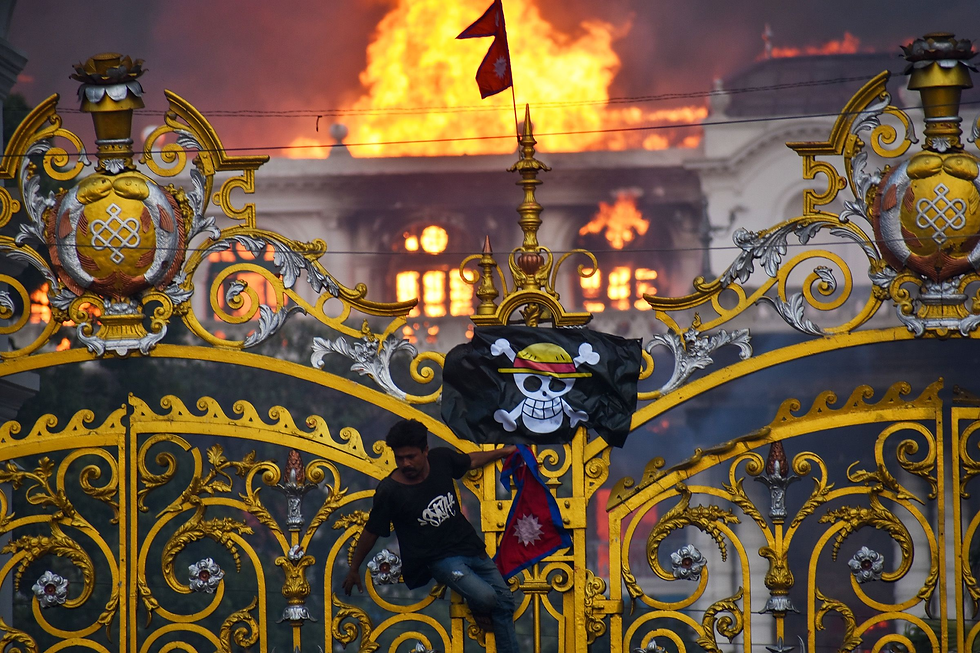
Security forces responded with tear gas, rubber bullets, and open fire, resulting in at least 72 reported deaths. Buildings associated with political power, including the parliament and government offices, were targeted in anger. Under pressure, Prime Minister KP Sharma Oli resigned, and an interim government was formed. Subsequently, Nepal elected its first female Prime Minister, Former Chief Justice Sushila Karki. The protests highlight both the youth’s deep dissatisfaction with longstanding governance and economic issues.

The South Asian Crisis: Beyond Nepal
Is this turmoil only Nepal’s problem, or part of a broader regional crisis?
While Nepal’s protests grabbed headlines, the unrest extends beyond its borders, reflecting a wider phenomenon across South Asia. Economically, countries such as Nepal, Pakistan, Sri Lanka, and Myanmar have struggled with slow GDP growth, rising inflation, high unemployment, and mounting public debt, leaving citizens anxious. Like in Nepal, youth unemployment and inflation have fueled growing public protests in Pakistan and Sri Lanka as well.

Political instability has compounded these economic challenges. As already mentioned, Nepal has experienced frequent government changes, corruption, and weak governance, while Pakistan faced mass protests linked to military tensions. Myanmar continues to grapple with the aftermath of a military coup. Bangladesh and Sri Lanka have witnessed large-scale protests triggered by poor economic management and declining living standards. Geopolitical and economic dependencies added another layer of pressure. Regional rivalries have influenced internal politics, while heavy reliance on foreign loans and international aid often led to sudden policy shifts, further fueling public anger.
These interconnected economic, political, and geopolitical pressures reveal a recurring pattern across South Asia: democracy exists on paper, but weak governance, poor economic management, and unfulfilled promises have repeatedly shaken public trust and sparked unrest. Understanding these challenges is key to securing a stable future through stronger governance, youth empowerment, and sustainable economic development.

The Future ahead
With these interconnected crises unfolding across South Asia, let us examine what lies ahead for Nepal and its neighbouring countries. Looking forward, Nepal and its South Asian neighbors might face both challenges and long-term opportunities. Politically, the interim government in Nepal may continue to face short-term stability challenges, and without meaningful reforms, repeated protests and growing youth discontent are likely.
Economically, on a broader level, South Asian nations need to prioritize sustainable growth and job creation. Countries like Pakistan, Sri Lanka, and Myanmar require policies to control inflation, reduce debt dependence, and strengthen domestic industries. Improved fiscal management, transparent governance, and efficient use of public funds are essential to prevent economic hardships from escalating into social and political unrest.
Digital platforms will remain central for public engagement and spreading awareness, highlighting the importance of open communication channels. Across the region, stronger collaboration on trade, investment, and infrastructure could foster economic stability while reducing excessive reliance on foreign loans and aid. Geopolitical rivalries must also be navigated carefully to ensure external pressures do not disrupt internal stability.
Ultimately, if nations invest in youth, improve governance, and address long-standing economic grievances, South Asia could gradually stabilize and achieve inclusive growth.


Comments