Economic History
- Economics Association Hyderabad Campus
- Jan 17, 2021
- 4 min read

Economic History is the academic study of economies or economic events of the past. It focuses on understanding the institutional dynamics of major economic events in the context of production, capital, labour, and the events impact on the society, state, culture, etc. One can convey a more superficial meaning by saying that it is just a study of how people lived their life, how they earned and spend, how they lived and died. The quantitative analysis of economic history is called cliometrics.
Economic history requires an evidence-based approach. It uses concepts, theories and skills to study economic, social and political developments. Economic historians deal with economic change over time. These include models on how to account for changes in the circumstances under which humans lived in the past. Economic historians' ability to border questions on complex economic, social and political issues and investigate patterns and outcomes of events within the past means they're often well placed to answer similar questions on current global economic developments and crises.
Economic history is not significantly different from orthodox varieties of history, and that is what matters. Like history, it asks questions - about demand and supply, production costs, distribution of wealth, income levels, overseas trade structure, and many more. Because economic history asks these questions, consequences follow; people who answer these questions must have an individual competence in handling the measurable variable and need to be able to use the relevant body of economic theory. All this is more complex than it seems. Answering these questions is frustrating. In layman terms, simply because it is concerned with how people lived, and why they behaved in a particular way, it is often challenging to discover relevant evidence. An individual's decision or way of life has a negligible impact on an economy or society's behavior as a whole. It usually happens that an individual's decision invalidates what society represents as a whole. Since individuals do not record for what posterity they buy, what they do at work or, how many children they have, economic historians need to reconstruct details from ambiguous evidence. This often leads to imprecision and increases the possibility of error.
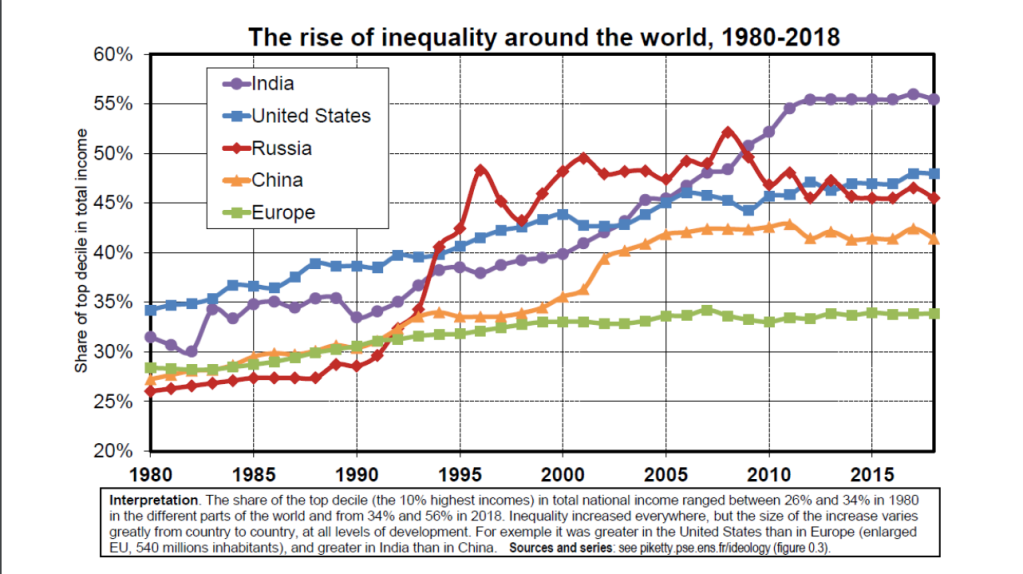
To elucidate, let us see how Thomas Piketty, a well-renowned economist, applies the concept of economic history to answer the age-old question; What happens to the economic inequality as countries develop?
Economic inequality is the unequal distribution of income and opportunity between different groups in society. It is a concern in almost all countries worldwide, and often people are trapped in poverty with little chance to climb up the social ladder.
It is generally assumed that the level of inequalities in developing countries is very high. This, however, is less than the inequalities in lesser developed countries. According to Piketty, the real problem in inequality among the less-developed countries lies in the extent of poverty as a whole, and not the difference in income levels. To simplify, it may be because of a larger proportion of people living below a certain standard of living, because of fewer opportunities to adhere to, or the country being poor. Concerned with how far the race to economic growth has affected income distribution, Piketty used economic history. He traced the historical pattern of inequalities and distinguished them from the changes in the last two to three decades. He observed that these historical patterns are more likely to be persisted. They concluded that economic inequalities widen when an economy grows and narrows down only in the later stages. Given several national particularities, the common pattern should be shown for all countries, and his conclusions were not objected to severe critique. The only doubts that arose were regarding the timing, the level of inequality, and some indicators' composition.
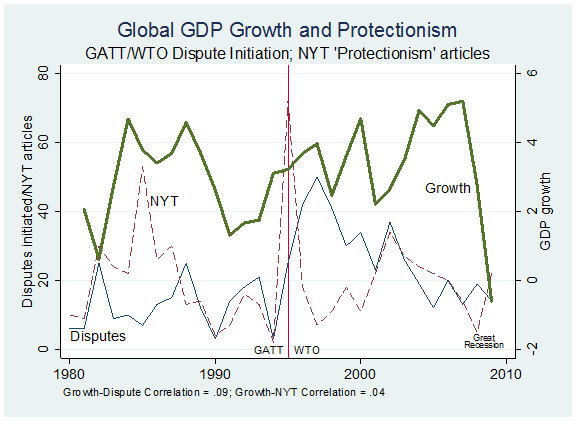
Another good example could be the relationship between protectionism and growth. Theorists have today concluded that higher the level of protection that a country adopts, lower will be its per capita income. The base behind this conclusion is nothing but historical evidence and the application of statistical methods and appropriate economic theory - the definition of economic history.
The specification problem in Economic History
Until the 1980s, it was believed that by answering and analysis key questions about the past, theorists could understand and account for the present in a better way. Economic history was the dominant paradigm guiding research. As time passed, the compatibility between history and policy started being undermined, leading to the progressive irrelevance of economic history to current financial questions. The dynamism is now gone. Apart from the theory itself, the validity in the efforts of cliometricians to apply the mathematical models of economics and map history to answer policy-related questions are also being questioned. The rise in new economics has provoked a debate on their methodology. The most severe criticism has been regarding the way cliometricians deal with questions that ask how the growth of an economy would have been different if one or two observed features of the running economy were absent. This criticism has arisen due to the growing trend of looking at historical events as the ultimate basis for the analysis of econometric models. Data from economic history are being assumed to be 'compendium of facts', and this has led to ambiguous data being used to analyse current models, increasing the possibility of error in the solution.
In recent years there has been a decline in the acknowledgement of economic history as a discipline. There has been widespread closure of economic history departments, which have been integrated into history or economics. However, it remains relevant as many policy-driven questions find its heart in this subject. No conclusion can be drawn without analysing historical evidence, in the context of economics, or anything as a matter of fact. However, historians have re-engaged with economic history through a new field, called the history of capitalism. Economic historians or cliometricians have failed to persuade to the new generation of economists that their crafts are relevant in answering questions of the present.


Comments