Loan In Yap
- Uday Sai Jagannadh Nandipati
- Jan 24, 2016
- 3 min read
YAP classically refers to an island—the Yap Main Islands— located in the Caroline Islands of the western Pacific Ocean.
Why a loan in Yap is hard to roll over?
The currency which we use today is made of paper. But a long time ago, it was in the form precious metals like gold and silver and also as stones. Do you know that there is an Island called Yap that even today uses stone as its major currency? Economists love it because it helps answer this really basic question: What is money? Read on to find more about this interesting place.
Yap is an island in the Caroline Islands of the western Pacific Ocean. On this tiny South Pacific island, life is easy and the currency is hard. Elsewhere, the world’s troubled monetary system creaks along. But on Yap the currency is as solid as a rock. In fact, it is rock. Limestone to be precise.
For nearly 2,000 years the Yapese have used large stone wheels to pay for major purchases, such as land, canoes and permission to marry. Yap is a U.S. trust territory, and the dollar is used in grocery stores and gas stations. But reliance on stone money continues.
Buying property with stones is “much easier than buying it with U.S. dollars,” says John Chodad, who recently purchased a building lot with a 30-inch stone wheel. “We don’t know the value of the U.S. dollar.” Others on this 37-square-mile island 530 miles southwest of Guam use both dollars and stones. Venito Gurtmag, a builder, recently accepted a four-foot-wide stone disk and $8,700 for a house he built in an outlying village.
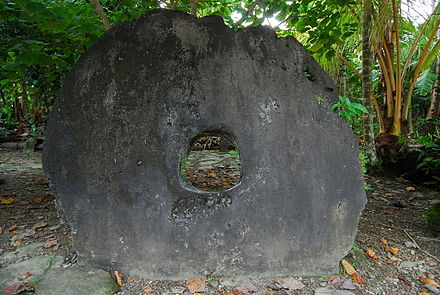
Stone wheels don’t make good pocket money, so for small transactions, Yapese use other forms of currency, such as beer. Beer is proffered as payment for all sorts of odd jobs, including construction.
Besides stone wheels and beer, the Yapese sometimes spend gaw, consisting of necklaces of stone beads strung together around a whale’s tooth. They also can buy things with yar, a currency made from large sea shells. But these are small change.
The people of Yap have been using stone money ever since a Yapese warrior named Anagumang first brought the huge stones over from limestone caverns on neighbouring Palau, some 1,500 to 2,000 years ago. Inspired by the moon, he fashioned the stone into large circles. The rest is history.
Yapese lean the stone wheels against their houses or prop up rows of them in village “banks.” Most of the stones are 2 1/2 to five feet in diameter, but some are as much as 12 feet across. Each has a hole in the centre so it can be slipped onto the trunk of a fallen betel-nut tree and carried. It takes 20 men to lift some wheels. By custom, the stones are worthless when broken. You never hear people on Yap musing about wanting a piece of the rock. Rather than risk a broken stone—or back—Yapese tend to leave the larger stones where they are and make a mental accounting that the ownership has been transferred.
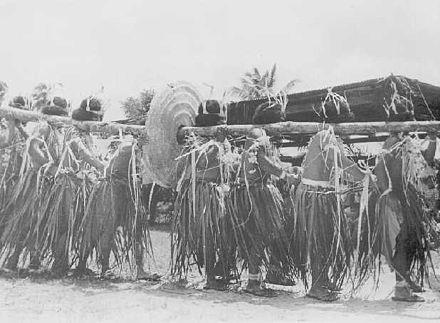
The worth of stone money doesn’t depend on size. Instead, the pieces are valued by how hard it was to get them here.
There are some decided advantages to using massive stones for money. They are immune to black-market trading, for one thing, and they pose formidable obstacles to pickpockets. In addition, there aren’t any sterile debates about how to stabilize the Yapese monetary system. With only about 6,600 stone wheels remaining on the island, the money-supply level stays put. “If you have it, you have it,” shrugs Andrew Ken, a Yapese monetary thinker.
But stone money has its limits. Linus Ruuamau, the manager of one of the island’s few retail stores, won’t accept it for general merchandise. And Al Azuma, who manages the local Bank of Hawaii branch, the only conventional financial institution here, isn’t interested in limestone deposits or any sort of shell game. So the money, left un-invested, just gathers moss.
But stone money accords well with Yapese traditions. “There are a lot of instances here where you cannot use U.S. money,” Mr. Gurtmag says. One is the settling of disputes. Unlike most money, stones sometimes can buy happiness, of a sort; if a Yapese wants to settle an argument, he brings his adversary stone money as a token. “The apology is accepted without question,” Mr. Chodad says. “If you used dollars, there’d be an argument over whether it was enough.”
-Uday Sai Jagannadh Nandipati


Comments