Musings on Money
- Economics Association Hyderabad Campus
- Aug 22, 2020
- 4 min read

Money has many roles and is not really as straightforward as our understanding of it may suggest. In this article, we are going to explore this and talk about the curious cases of Chile and Zimbabwe.
There are two important roles of money-it is a storage of value and a unit of account. It means that money is used to buy stuff and is also used to keep track of things like how much you owe somebody.
Let's talk about the storage of value first:
To start, try to answer the question- what happens when one crore rupees is burned. The question doesn't seem to be realistic. After all, if someone doesn't want that money, they could just donate it. Who would be cruel enough to waste one crore rupees when so many in India are extremely poor and have to survive off of next to nothing. Anyone who does burn said money would be heavily criticized. In reality, though, a person burning his money is, in essence, actually donating his money and distributing it to everyone. This is because money inherently has no value and represents the purchasing power to buy real value. By burning their money, the person would effectively be donating their purchasing power to all the citizens holding that currency.
Also, the central bank can generate that amount with the click of a button. That's not all though, the money that has now been generated belongs to the government. So in the click of a button, the government is now an extra one crore rupees richer. The only loss in that 1 crore is the cost to print money(which isn't much). In this case, though, everyone's purchasing power is not enhanced by the whole situation as the money in circulation has not changed.
The above paragraph raises a question: Why doesn't the government keep creating more money whenever it needs funds instead of collecting taxes from the citizens. Well, it doesn't work that way; money by itself doesn't actually have any real value; it is merely a representation of purchasing power. If money doesn't have any inherent value, then creating more money just means that more money(in the economy) will be used to transact for the same pre-existing real value in the world. This means that the purchasing power of money ends up getting reduced. Before we know it, the value of the Rupee will be close to nothing. We might then require 10k Rupees just to buy an apple.
This general rise in price level relative to available goods is the infamous inflation. A slow and controlled increase in the money supply is, in fact, good for the economy as it can increase the economy's output. Inflation starts when output is pushed to its capacity and can't rise much more, but the money supply continues to grow. Generally, we measure inflation by the annualized percentage change in the consumer price index.
So, policymakers have to watch how much money they pump in, but, in the case of some problems in the country, they might be forced to pump in huge amounts of money, leading to a high inflation rate.
When this continues, people start expecting the price of goods to increase, and they no longer save their money. They start spending more and more, leading to a massive increase in demand, which in turn once again causes higher prices. The increase in "the velocity of money" pushes inflation up at an even faster rate. We can then get a vicious cycle that causes prices to rise more and more, causing the dreaded hyperinflation.
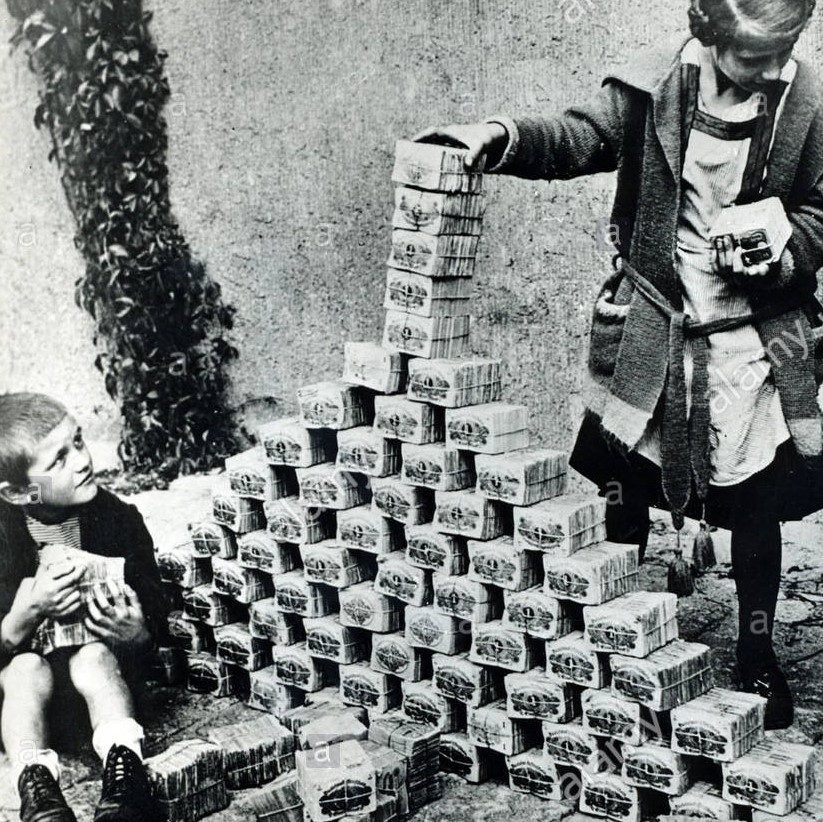
This brings to the 2nd role of money- it acts as a unit of account. If the purchasing power of money keeps on decreasing at a rapid rate, money wouldn't really act as a great way to keep an account. This is because money that can buy 20 cars today would not be worth one car a month later. Such a fickle measure of account creates a lot of uncertainty and severely limits trade. This leads to a supply issue and once again pushes up the prices.
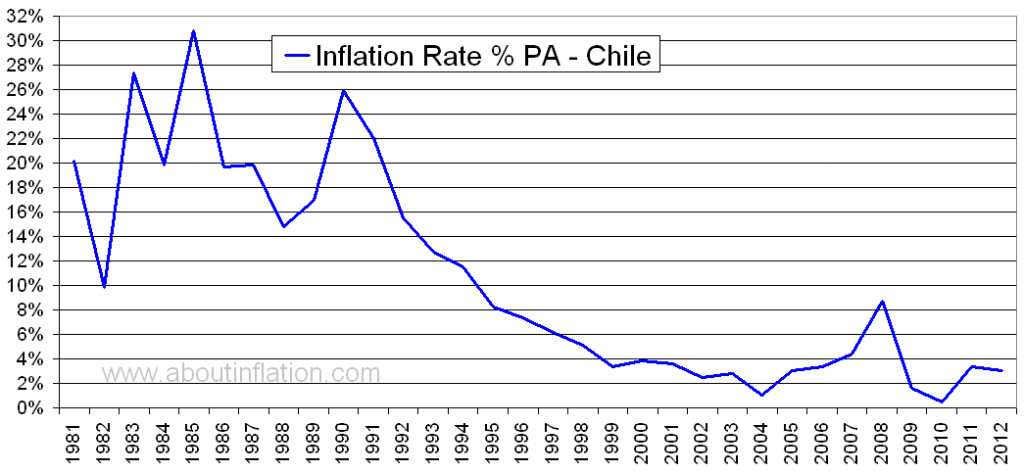
Chile in 1967 was going through hyperinflation and recognized this problem. They created a new unit of account that does not fit with our standard understanding of money called the "Unidad de Fomento(UF)." No UF coins or notes are circulating, and it exists as a purely abstract unit-of-account, totally divorced from any media-of-exchange. The exchange rate between the UF and the Chilean peso(their standard currency) is continuously adjusted for inflation. The value of the Unidad de Fomento remains almost constant daily.
To explain this system, here is an example: say you rented a house for 1 UF, which was at that point worth 23k pesos. Now, if the government adopts an easy money policy and seven months later, the peso's purchasing power has fallen by around 10%. Now, the rent would still be 1UF, but the value of 1 UF is far different. It might now be valued at 25k pesos. In this, while the rent payment is nominally higher, the payment's UF value is constant, and in effect, the transaction represents the same quantity of CPI(Consumer Price Index) baskets as seven months before.
In Chile, real estate, rent, mortgages, car loans, long term gov securities, taxes, pension payments, and alimony are all priced using UF. This UF/Peso system is similar in many ways to a partially dollarized economy in which the US dollar has been adopted as the unit in which to price long term contracts(to ensure stability and instill confidence) while the local currency is used to price current goods and services. Zimbabwe is an extreme example of this, where it had to abandon its currency altogether due to hyperinflation. Now, its citizens use USD and other currencies for all their transactions. This has, in fact, been instrumental for them to stabilize their prices. Robert Shiller, a Nobel Laureate and Professor of economics at Yale, believes that because people tend to succumb to money illusion when dealing with inflationary episodes, the adoption of indexed units-of-account may be the most palatable way to reduce the problem.


Comments