The Economic Gamble of Hosting the FIFA World Cup

Spain just lifted the 2026 World Cup trophy, but the real winner is walking away with a staggering $15 billion. While the host countries foot the massive bill for stadiums and security, FIFA gets to take the profits home tax-free. Here is a simple look at the wild economics behind the world’s largest and most expensive football league.
Even though FIFA makes billions of dollars, its main office is located in Switzerland for a few very smart business reasons. When the organization moved there in 1932, they specifically chose the country because it stays out of global wars, offers huge tax breaks, and has very few government rules for international sports groups. This clever decision meant FIFA could keep almost all the money it brings in without the government interfering, allowing them to build the massive, tax-free empire they run today. Why Nations Fight to Host the Tournament ?
Governments aren't just buying the rights to host the world cup, they are buying the attention of five billion people. Hosting the World Cup is the ultimate exercise in "soft power." It is a massive, month-long advertisement to boost national prestige, reshape a country's global image, and show the rest of the world that they are a powerful geopolitical player.
Nations aggressively bid to accumulate "soft power," using the global spotlight to shape their international image and influence foreign policy. For instance, Qatar utilized the 2022 tournament to shift its global perception and project the image of a technologically advanced, modern state. Developing countries view hosting as a vital opportunity to reinforce their credibility and signal their arrival on the world stage.

The Government and Taxpayer's Gamble
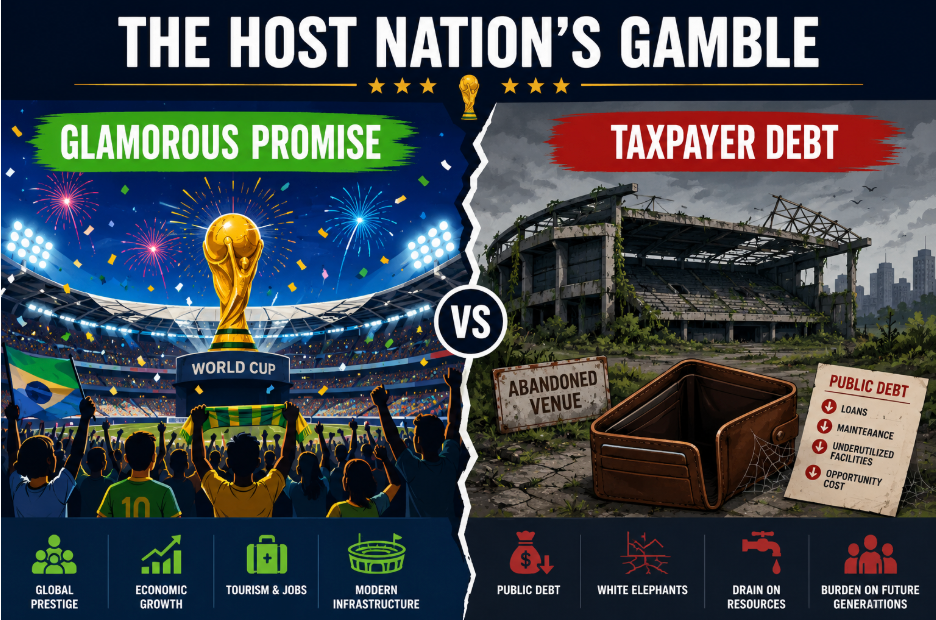
While the idea of hosting is glamorous, the reality is incredibly expensive. The most infamous cost of hosting is building massive, state-of-the-art stadiums in cities that don't need them. Brazil spent an estimated $11.6 billion on the 2014 World Cup, including massive stadiums in cities. Today, many of those billion-dollar stadiums are rarely used. Even if a country avoids building new stadiums like the US, Mexico, and Canada cleverly did for 2026 the costs are still staggering. US host cities faced estimated public costs of $100 million to $200 million each just to cover police, emergency response, traffic management, and public fan zones.
When governments pitch the World Cup, they promise long-term community development like new subways, upgraded airports, and better roads. But as the tournament gets closer, that money gets hijacked for four weeks of pure entertainment. Instead of building schools or hospitals, public cash goes toward giant stadiums and luxury VIP suites that sit empty once the games end. In the end, taxpayers are left with the heavy debt of a short-lived party, while the permanent improvements they were promised get tossed aside.
The FIFA Machine: How the House Always Wins
While host nations absorb all the financial risk, FIFA extracts pure profit through three massive revenue streams: multi-billion-dollar TV broadcasting rights, global corporate sponsorships, and ticket sales. But the real masterstroke is the infamous "tax bubble." As a strict condition of hosting, FIFA forces host governments to pass special laws granting FIFA and its commercial partners total tax-free status. This means when fans buy match tickets, overpriced beers, or official jerseys, local governments collect virtually zero sales or corporate tax. Ultimately, local taxpayers are left footing the entire bill for the tournament while FIFA funnels billions in tax-free profit straight back to its Swiss headquarters.
Despite operating a multi-billion-dollar sports empire, FIFA is legally classified as a Swiss non-profit association, meaning it pays virtually no corporate taxes and has no private shareholders to answer to. Instead of paying out dividends, FIFA stockpiles its massive World Cup profits and hands out equal, multi-million-dollar development grants to all 211 of its member countries. The political genius behind this system lies in how FIFA elections work: every single nation gets exactly one vote. This means a tiny island country has the exact same voting power and receives the exact same financial payout as soccer giants like Spain or Brazil.
Do the Hosts Actually Make Money?
Hosting the world's most-watched sporting event provides immense global visibility allows a country to present its unique culture, modern facilities, and capabilities to the world, rapidly improving its international image. When governments focus on broader civic improvements, the World Cup leaves behind modern facilities that improve the quality of life for residents and foster long term economic growth.
The media always focuses on the massive waves of international fans flooding into the stadiums with their flags but in reality, host country residents almost always buy the majority of World Cup tickets. For example, during the 2014 World Cup, Brazilians bought a staggering 60% of all tickets. Massive percentage of those fans are actually locals, that isn't new wealth entering the local economy.
The World Cup is the ultimate trade-off between athletic glory and harsh financial reality. For the champions, the tournament yields legendary status, for the traveling supporters, an exhilarating experience bought at premium prices.


Comments