NITI Aayog

The Planning Commission of India, since its formation on 15 March 1950, supervised the five-year plan for the economic development of the country. However, in 2015, the 65-year-old Planning Commission was dissolved, and a policy think tank – NITI Aayog (National Institution for Transforming India) took its place. For a long time, the significance and utility of the Planning Commission had been questioned. The replacement of the Planning Commission seemed to be more conscious and relevant considering the present economic needs and scenario in the country.
Unlike its predecessor which had the power to allocate funds to States for regional development, the NITI Aayog has no such powers. The Finance Ministry’s Department of Expenditure allocates funds now. The Aayog’s primary responsibility is to undertake long-term policy and design frameworks, along with taking necessary initiatives for faster development. NITI Aayog never plans, it formulates policies. Projects based on these policies are prepared by different ministries of the Central Government. NITI Aayog also provides relevant technical advice to the Centre and States.
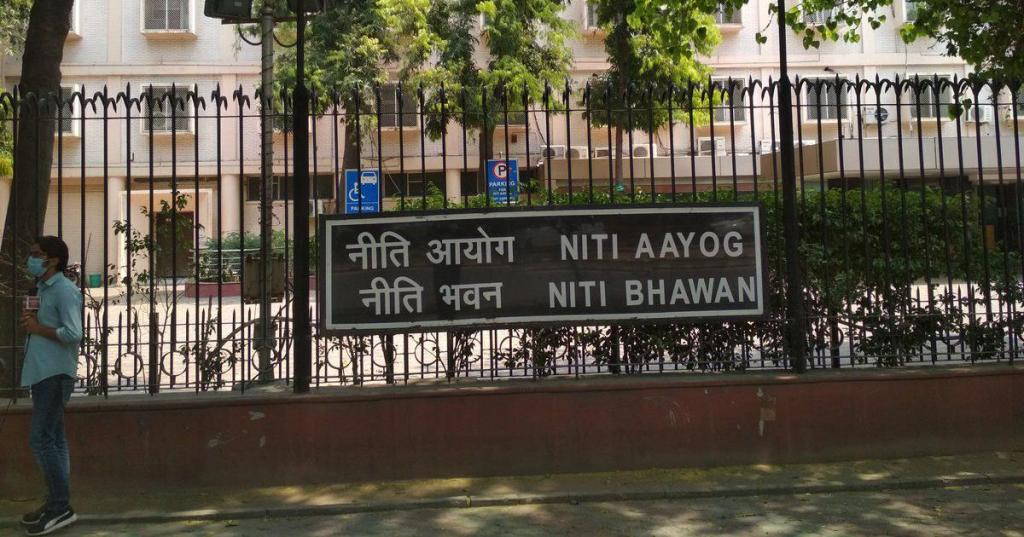
The NITI Aayog’s creation has two hubs:
Team India Hub: It leads to the participation of Indian states with the central government.
The Knowledge and Innovation Hub: It builds the institution’s think tank capabilities.
NITI Aayog’s entire gamut of activities can be divided into four main heads:
Design Policy & Programme Framework
Foster Cooperative Federalism
Monitoring & Evaluation
Think Tank and Knowledge & Innovation Hub
The NITI Aayog comprises the following:
The Governing Council, with the Prime Minister as its Chairperson, containing the Cheif Ministers of all states and Lt. Governors of Union Territories.
Regional Councils created to address particular issues and possibilities affecting more than one state. These are formed for a fixed term and consist of the Chief Ministers of States and Lt. Governors of Union Territories.
Experts and specialists in various fields.
The full-time organizational framework will include, in addition to the Prime Minister as the Chairperson:
Vice-Chairperson (appointed by the Prime Minister)
Four full-time members
Part-time members: Maximum of 2 members from foremost universities, leading research organizations, and other innovative organizations in an ex-officio capacity.
Ex Officio members: Maximum of 4 members of the Council of Ministers which is to be nominated by the Prime Minister.
Chief Executive Officer: CEO will be appointed by the Prime Minister for a fixed tenure. He will be in the rank of Secretary to the Government of India.
How is NITI Aayog relevant?
Acts as an Action Tank: NITI Aayog acts like an action tank and not just as a think tank. By collecting fresh and new ideas and sharing them with the government at the Central and State level, it lifts frontiers and ensures that there is no inactivity in any organization or institution.
Improving innovation: A commendable work has been done by The Atal Innovation Mission, which is established under NITI Aayog, it has helped in enhancing the innovation ecosystem in India. More than 1,500 Atal Tinkering Labs have been established in schools across the country and it is anticipated that this number will cross 5,000. It has also set up Atal Incubation Centres to encourage start-ups and young innovators.
Development Monitoring and Evaluation Office has been established by the NITI Aayog, which collects performance data of various Ministries on a real-time basis. This data is then used at the highest policy-making levels to improve performance and establish accountability. NITI Aayog also computes ranks of the States based on their performance across various indicators to promote a spirit of competitive federalism.
NITI Aayog plays a significant role in being the representative of States in Delhi and facilitates direct communication with the line ministries, which helps in addressing issues in a relatively shorter time.
Significant policies and programs
POSHAN Abhiyaan
Launched by the Prime Minister on the occasion of the International Women’s Day on 8 March 2018 from Jhunjhunu in Rajasthan, the POSHAN (Prime Minister’s Overarching Scheme for Holistic Nutrition) Abhiyaan directs the attention of the country towards the problem of malnutrition and address it in a mission-mode. NITI Aayog has played a critical role in shaping the POSHAN Abhiyaan. The National Nutrition Strategy, released by NITI Aayog in September 2017, presented a microanalysis of the problems persisting within this area and chalked out an in-depth strategy for course correction. Most of the recommendations presented in the Strategy document have been subsumed within the design of the POSHAN Abhiyaan and now that the Abhiyaan is launched, NITI Aayog has been entrusted with the task of closely monitoring the POSHAN Abhiyaan and undertaking periodic evaluations.
Atal Innovation Mission
The Atal Innovation Mission (AIM) is a flagship initiative set up by the NITI Aayog to promote innovation and entrepreneurship across the length and breadth of the country, based on a detailed study and deliberations on innovation and entrepreneurial needs of India in the years ahead.
Major initiatives under AIM:
Atal Tinkering Labs: To develop problem-solving mindset across schools in India.
Atal Incubation Centers: For fostering world-class startups and adding a new dimension to the incubator model.
Atal New India Challenges: For promoting product innovations and aligning them to the needs of various sectors/ministries.
Mentor India Campaign: A national Mentor network in collaboration with the public sector, corporates and institutions, to support all the initiatives of the mission.
Atal Community Innovation Center: To stimulate community-centric innovations and ideas in the unserved/underserved regions of the country, including Tier 2 and Tier 3 cities.
ARISE: To stimulate innovation and research in the MSME industry.
Sustainable Development Goals
NITI Aayog has been entrusted with the role to co-ordinate ‘Transforming our world: the 2030 Agenda for Sustainable Development’ (called as SDGs). Moving ahead from the Millennium Development Goals (MDGs), SDGs have been evolved through a long inclusive process for achievement during 2016-2030. The SDGs cover 17 goals and 169 related targets resolved in the UN Summit meet 25-27 September 2015, in which India was represented at the level of Hon’ble Prime Minister. These SDGs will stimulate, align and accomplish action over the 15-year period in areas of critical importance for the humanity and the planet. NITI Aayog monitors and collects data to help leaders and change-makers evaluate their performance on social, economic and environmental parameters. It aims to measure India and its States’ progress towards the SDGs for 2030.
Other major policies and programs
SATH
SATH is aimed at initiating transformation in two key social sectors—education and health, by hand-holding States towards improving their social sector indicators and providing technical support.
Women Entrepreneurship Platform
To promote and support established as well as aspiring women entrepreneurs in India.
Blockchain
NITI Aayog provided a framework for states and ministries on how and where they can take up blockchain and when they should do it.
.
Methanol Economy
Program initiated by NITI Aayog aimed at reducing our oil import bill, reducing greenhouse gas emissions & converting Indian coal reserves and municipal solid waste into methanol.


Comments