What's in a Neighborhood?
- Revanth Reddy
- Feb 26, 2021
- 4 min read
Moving to Opportunity for Fair Housing (MTO) was a randomized social experiment sponsored by the United States Department of Housing and Urban Development (HUD) in the 1990s among 4600 low-income families with children living in high-poverty public housing projects.
This experiment randomly assigned occupancy to residents who were earlier living in high poverty residential areas, to non-poor areas. The main aim was an administrative analysis of neighborhood impacts on these residents. The idea behind this project was to mitigate the detrimental effects a poor neighborhood might have on its residents.
In the real world, residents choose their neighborhoods. They live in areas which they think fit in their social standing. These choices may lead to unmeasured characteristics, which affect other outcomes as well. Usually, these neighborhood effects are confused with factors within one's own family, and a solution is lost. The Moving to Opportunity for Fair Housing scheme provided first-hand techniques to measure these effects without confounding factors.
the experiment
Sponsored by the HUD, the Moving To Opportunity experiment was conducted in 5 cities - Boston, Baltimore, Chicago, Los Angeles and New York. Families eligible for the program had children below 18 and lived in project-based assisted housing, or public housing developments. These families were a part of high-poverty areas. Families that were interested were placed on waiting-lists and were divided into three groups:
Experimental Group: These families received rental assistance vouchers, but they could only be used if they moved to non-poor areas. These were areas with less than 10% poverty rate. Non-profit organizations helped these families find a suitable leasing/renting site in a low-poverty area within the given time frame.
Section 8 group: These families received rental assistance vouchers which could be used anywhere. However, no counselling was provided.
Control Group: These families received no vouchers whatsoever, but were eligible for public housing developments or project-based assistance.
The HUD unit driving the experiment had specific expectations regarding the mobility of these families after they had been allotted a group, i.e. they hypothesized that:
a. The experimental group would have difficulties moving to low poverty area, both mentally and figuratively.
b. The section 8 group would be the most volunteering to move neighbourhoods.
c. The control group would reside in the original project-based housing units they initially lived in.
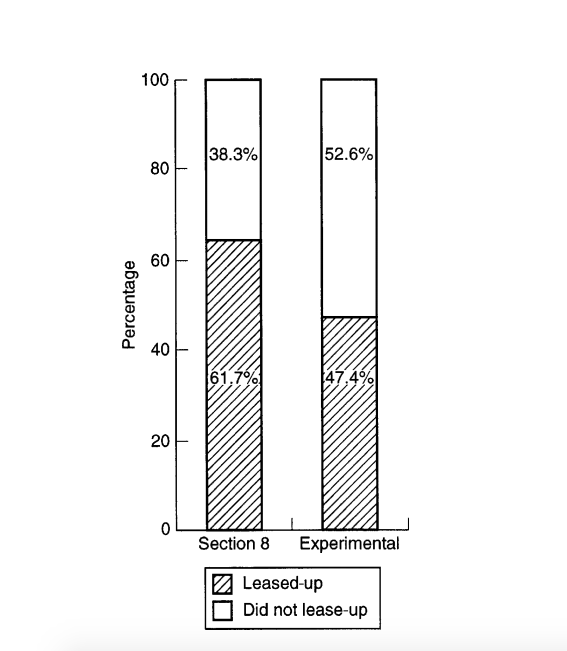
As shown in the figure, only 47% of the families allotted to the experimental group for interim evaluation moved out, will 62% of the section 8 group moved out.
All the randomly assigned families were tracked from time to time, to measure the mid-term and long-term outcomes across all three groups.
In the following 4-7 years of the allotment, the mobility of families was quite visible.
Impacts of the experiment
Geographical Impacts
Even after random assignment, it was seen that a % of experimental group families moved to higher poverty areas. A higher percentage of control group families, on the other hand, moved to lower-poverty areas. However, the low-poverty areas to which experimental group families moved had lower poverty levels than those of control group families. This was mainly attributed to the administered movement of the experimental groups by counselling from non-profit organizations. Section 8 groups' families fall in between.
Neighbourhood conditions and Safety
There were substantial program effects on a variety of measures related to the neighborhood, especially on the experimental group and section 8 group. These changes were in terms of neighborhood quality ( littering, public drinking, etc.), neighborhood safety (feelings of safety at night, people witnessing drug transactions, etc.) and people's quality. These positive effects were particularly large for the experimental group compared to section 8 and control group families. Taken together, MTO's results in this domain showed clear neighborhood and safety improvements relative to controls, and they were of great importance to the many participants whose primary motivation for joining MTO was improved safety.
Duration of exposure to neighborhoods lower in poverty than currently allotted
It was seen that the experimental group materially reduced time spent in lower-poverty areas and time spent in areas with less than 20% poverty rate increased significantly.
The primary motivation for families volunteering for the MTO program were the dangers in their current housing development areas. More than 82% stated that the primary reason for wanting to move was to get away from drugs, gangs and crime. A high proportion of residents stated the following as big problems:
Presence of abandoned buildings (38 per cent)
Presence of litter or trash in the streets (53 per cent)
Presence of graffiti (63 per cent)
Presence of drug dealers (87 per cent)
Only one-third felt safe or very safe on the street during the day, and just 12 per cent felt secure or very safe on the road at night. Most striking, only 4 per cent felt very safe when home alone at night.
Many applicants for this program came from families living in public housing for generations. These included people whose daughters raised their children while living with parents, children with asthmatic mothers and parents diagnosed with other problems etc. MTO offered a chance for these people to obtain their own housing and own living subsidies.
Interpretation of Results
Substantial positive effects were observed in the program. Though the control group's mobility was maximum among the three, the experimental and section 8 groups rate their current neighborhood as far better than before. The MTO program had produced notable improvements in the neighborhood conditions of all groups. Within experimental and section 8 groups, the experimental group's estimated effects were twice as large compared to section 8 group movers. The overall poverty rate of families moved under this program fell, with the maximum fall observed in the experimental group.
Conclusion
Moving to Opportunity is a carefully designed, large demonstration to measure the impact of neighborhood on the lives of very low-income families with children who initially lived in subsidized housing developments in the concentrated-poverty areas in very large cities. As implemented, therefore, MTO serves as a platform for unbiased measurement of the ways that improvements in neighborhood can change the lives of very-low-income families with children. The experiment continues to affect the lives of participating families in positive and important ways, giving them access to better-quality and safer living environments.
- Revanth Reddy


Comments