Economics of Airline Network Planning

Updated: May 21, 2025
Not very long ago, Late Jhunjhunwala’s backed Akasa Air launched with its maiden flight on the Mumbai-Ahmedabad route, India’s newest airline is all set to finally launch its operations in the country’s largest aviation market- New Delhi. It will be the 6th destination for the airline in the country (after Mumbai, Bengaluru, Kochi, Chennai, and Ahmedabad) as the airline opened bookings on its Bangalore-Delhi and Ahmedabad-Delhi route w.e.f 8 October 2022. The aircraft will be based in Bengaluru.
While this is one of the very initial sectors the airline will fly, What more routes could you see the airline flying next, and does your home airport feature in that list? To answer this question would take us to go back to the basics of the economics of airline network planning.
For an airline to fly a route, the most fundamental condition is that the route should be economically viable, i.e., It should have the traffic to make money, and as they often say in the language of aviation, Yields (Profitability) need to be maximised. This is often the tip of an iceberg bound by several other factors coming into action, like timings, slot holding, aircraft rotation, maintenance/parking etc. and is often a play of network planning.
What gets different for new airlines like Akasa in the early growth stage?
While all the significant fixed costs of the industry in the likes of Aviation Turbine Fuel, Landing and Parking Charges of Airport, UDF etc. remain the same for all the airlines. What makes it significantly different for new airlines compared to existing airlines is the unit cost economics at the airports they operate. To understand this, Let’s take two scenarios;
1) Scenario 1: The airline has based its aircraft at airport A and started flying on five routes connecting A with the airports: B, C, D, E, and F. In this scenario, the airline operates on five routes using six airports.
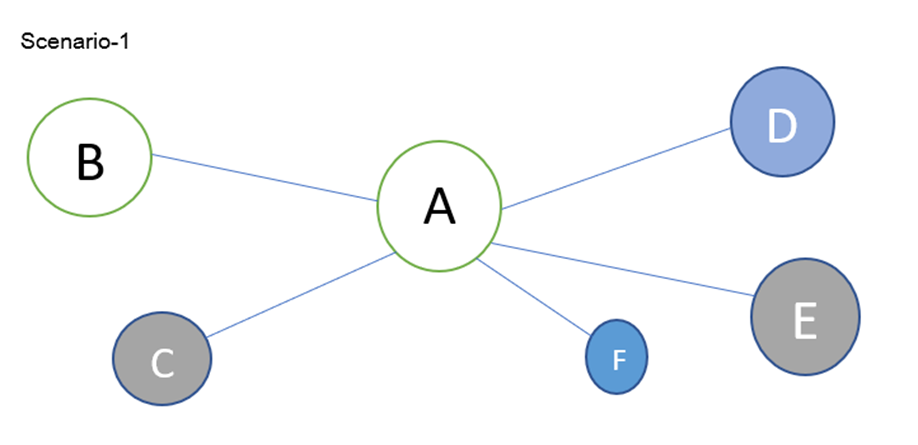
2) Scenario 2: The airline has based its aircraft at airport A and connects it with three airports- B, C, and D apart from connecting B, C, and D with each other. In this scenario, the airline operates on six routes using only four airports.

What scenario could be better and more cost-effective for an Ultra-Low Cost Airline like Akasa Air?... The obvious answer is 2 because, in this case, the airline gets to fly on more routes while operating to fewer airports, and this takes us to Rule 101 of the Economics of Airline Network Planning of a Low-Cost Airline: Connect the dots.
Connect The Dots: Economics of Airline Network Planning into play
While this factor gets eclipsed by other factors and becomes irrelevant to an extent after an airline reaches a certain level of scalability, it plays a crucial role when the airline is at its initial levels of growth. The rule is to Connect the dots, which means during the initial scale of expansion and reaching scalability, the airline must try to minimise the number of new airports it operates to and must try flying maximum between the existing airport it operates. But one might wonder why?
Well, while the idea of flying to multiple destinations might sound exciting at first but the first bad news for airlines is that operating to a new airport comes with a very high amount of certain costs- You need to hire ground and handling staff, get the check-in counters along with staff and a new set of managers to manage them at every new station, equipment like satellite aerobridges/stairs in case of LCC’s needs to be transported to the respective airport. This makes your customer acquisition cost (CAC) very high for opening up a new airport as a destination compared to flying more between airports where you already have the infrastructure available for operations. Also, you can effectively increase work output from your current staff in this scenario, reducing overall costs.
While all of this infrastructure is present in case the airline decides to fly between existing airports than opening up a new airport, the cost of opening up a new airport as a destination can be eliminated.
This is why airlines in their initial days try to fly maximum between airports they already fly to or to say they try to Connect the dots than opening more dots. This is why when Akasa air-launched its initial routes on Ahmedabad-Mumbai and Bangalore-Kochi sector, it was very highly expected that the airline would eventually launch on the Mumbai-Bangalore route (to connect the dots) and not very unsurprisingly, Mumbai-Bangalore followed to be the next route airline announced and as of now, the airline runs four times daily on Mumbai-Bangalore route. Now that the airline has already announced to fly to Delhi from Bangalore and Ahmedabad, it would not be wrong to anticipate that following the rule of connecting the dots; the airline might very soon as well launch on any of the Delhi-Mumbai, Delhi-Kochi or Delhi-Chennai routes as they already operate to these three airports currently.
What other routes the Akasa Air could fly on from Delhi?
From now, it is evident that during the initial scale of expansion, whenever an airline chooses to fly to a new airport as a destination, it often sees that investment of making that airport a base of an airline in the long term, with the intention to fly more potential routes from that airport to reduce effective costs of being present at that airport. This is precisely why airlines usually expand in the hierarchy of more busy to less busy airports because they can put on more frequencies in busier airports, making it more economical to fly to busier airports in the initial state.
For now, Akasa Air will not have a base in Delhi airport, and both of these flights of the Ahmedabad-Delhi and Bangalore-Delhi sectors will be based in Bengaluru. Still, suppose Akasa plans to make its base in Delhi in future. In that case, it will likely fly on high-traffic routes Eg-Delhi first in the likes of Delhi-Amritsar, Delhi-Jaipur, Delhi-Lucknow, or Delhi-Srinagar, creating a networking strategy in the up north.
The Bottomline
Although you can accurately estimate the probable routes the airline could fly to in the future, it is almost next to impossible to predict them with certainty beforehand. While economics is one aspect of network planning, many other factors and obligations come into play, like aircraft availability, landing and parking costs of particular airports, slot availability at those airports, DGCA Regulations, and the RDGs; the final decision is taken only after considering all of them. Hence, it won’t be surprising if a comparatively less economical route is chosen first over a more economical route due to slot availability issues or the RDGs and is, in fact, a practice prevalent in the industry and therefore to accurately predict with complete precision on what routes the airline could fly to next is something not even the planners in the airline can tell today. But what goes into taking a guess? What do you think?
-Sanchit Chugh


Comments